This blog contains something related to Literature such as drama, novel, literary research, film
Wednesday, August 27, 2008
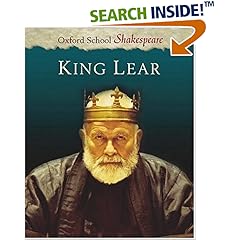
The Tragedy story : "King Lear (Oxford School Shakespeare) "
Description
The Oxford School Shakespeare is a well-established series which helps students understand and enjoy Shakespeare's plays. As well as the complete and unabridged text, each play in this series has an extensive range of students' notes. These include detailed and clear explanations of difficult words and passages, a synopsis of the plot, summaries of individual scenes, and notes on the main characters. Also included is a wide range of questions and activities for work in class, together with the historical background to Shakespeare's England, a brief biography of Shakespeare, and a complete list of his plays. Roma Gill, the series editor, has taught Shakespeare at all levels. She has acted in and directed Shakespeare's plays, and has lectured on Shakespeare all over the world.
Review: By Brian Smith "criacow"
One of literature's classic dysfunctional families shows itself in King Lear by William Shakespeare. King Lear implicity trusts his three daughters, Goneril, Regan, and Cordelia, but when the third wishes to marry for love rather than money, he banishes her. The two elder ones never felt Lear as a father; they simply did his bidding in an attempt to win his favor to get the kingdom upon his death. Cordelia, on the other hand, always cared for him, but tried to be honest, doing what she felt was right. As Lear realizes this through one betrayal after another, he loses his kingdom -- and what's more, his sanity...
The New Folger Library edition has to be among the best representations of Shakespeare I've seen. The text is printed as it should be on the right page of each two-page set, while footnotes, translations, and explanations are on the left page. Also, many drawings and illustrations from other period books help the reader to understand exactly what is meant with each word and hidden between each line.
Great Shakespeare's work : "King Lear (Arden Shakespeare: Third Series) "
Description
'By far the best edition of King Lear - in respect of both textual and other matters - that we now have.' John Lyon, English Language Notes 'This volume is a treasure-trove of precise information and stimulating comments on practically every aspect of the Lear-universe. I know of no other edition which I would recommend with such confidence: to students, professional colleagues and also the 'educated public'.' Dieter Mehl, Shakespeare Jahrbuch, vol 134
Review; By Cromulus "Magnus Cromulus"
The Arden edition of King Lear (I believe this one is in its third printing) is a combination of both the Quarto and the Folio editions of the play. Of course, when you end up with a conflated edition (one that is made up of both) you are left at the mercy of the editor but, for my money, R.A. Foakes does an excellent job of integrating the manuscripts and often points out in the notes which and why certain choices were made.
Other people have summarized the plot of King Lear here at amazon.com so I won't engage in that sort of review. I will concentrate instead on the particular edition and why I think it's among the best and then I will point out some things to look for in the play, things that I believe deserve close attention, things that will add to your enjoyment of the play.
First of all the Arden edition - the book is basically divided into two major parts: the essays and the play. The play occupies the top half of each page, while the editorial notes and "translations" are found on the bottom. So, for example, when King Lear first lets us know about "divesting" his kingdom, Foakes tells us that this word is important because it sets an important pattern regarding clothes throughout the play.
Sometimes the observations are incisive and surprisingly good, sometimes not as good. For example, when Lear starts talking about "By all the operation of the orbs / From whom we do exist, and cease to be", Foakes points out that the orbs are the planets (during Shakespeare's lifetime, the alignments of the planets was important - the word "disaster" actually means stars out of alignment - the kind of worldview that held the earth as the center of the universe was the worldview that Shakespeare inherited and lived in). But Foakes fails to mention that the orbs are also our EYES and in their full operation, opening your eyes can make one "exist" (as in we see them) and closing your eyes can make one "cease to be" (as in you don't see them). Furthermore, the orbs can be seen as being the eyes of God and us existing in them. Bishop Berkely's philosophy relied heavily on the idea that everything exists because God perceives it.
Anyway, just realize that the greatest of notes are nowhere near as good as the greatest of care and attention when reading. Especially when reading the greatest writer that ever lived.
Now onto some things I believe everyone should pay attention to. The word "love" appears in the play more than any other word of meaning (obviously I'm excluding words like "the" in the search). Now if you combine language that are related to eyes (sight, orbs, look, see, etc) you will also notice a great preponderance of these words. The same thing will happen if you combine the other senses (touch, feeling, smell, etc). Why is this of any import? Well, if you're going to write about something, you're going to have to use words. If something is important, you're going to want to drive that point home so you will be using some words more than others. This is an indication that the play you're reading is going to be about those things. So "love", "seeing", "nature", "clothes" and animals such as "dog, snake, wolf, etc" are words that appear a lot and are important.
Sometime Shakespeare is so goddamn clever that you could spend a lifetime and not catch everything. For example, it wasn't until my 2nd reading of the play that I noticed he tells Kent
"Our potency made good, take thy reward.
Five days we do allot thee, for provision
To shield thee from diseases of the world;
And on the sixth to turn thy hated back
Upon our kingdom: if, on the tenth day following,
Thy banish'd trunk be found in our dominions,
The moment is thy death. Away! by Jupiter,
This shall not be revoked."
Notice the word "provision". The root of the word is pro-vision. It means to look ahead. Later on in the play Kent reappears, in disguise! Is Shakespeare having fun with us or am I reading too much into what could be an unintended use of the word? Let me put it this way - if I'm going to find morsels like this one, Shakespeare gets the credit.
The words relating to seeing and feeling are especially important if you take tragedy to be an epistemological problem. If the tragic figure is one that denies a kind of knowledge (Lear and Gloucester certainly do this) then one can deny it by not seeing or feeling, hence the words that relate to the acquisition of knowledge through empirical means. Notice in the above verses that Kent will be told to re-appear, but he can only reappear in disguise. Lear has already denied his love and devotion. Kent must reappear as something else to allow Lear to "love him" again.
Lastly, pay close attention to Shakespeare's doubling and mirroring. This is a favorite thing of his to do. I remember that the first time I read "Measure for Measure" I noticed doubling and mirroring on every page. Then I read it again and noticed these things every 5 lines. Then I read it again and started noticing them with ever increasing frequency! In King Lear the mirroring is much more subtle and even more rewarding. Notice how Goneril ends up "confusing" Gloucester with Lear when she tells him to "smell" his "way to Dover". From that moment on Gloucester and Lear become doubles and possibly even more and the reader becomes a party to the confusion.
Reading Shakespeare is a mind blowing experience and King Lear is probably his greatest play (and that's saying something considering he also wrote "Hamlet", "Othello" and "Macbeth").
Shakespeare wrote this play towards the end of his playwright's career. He had two daughters, one of which was a bit of an embarrassment to him. It's fun to hypothesize whether retiring was on his mind and if it was his own intent
"To shake all cares and business from our age;
Conferring them on younger strengths, while we
Unburthen'd crawl toward death."
I cannot leave a review of King Lear without mentioning some important essays on it. A few years back philosopher Stanley Cavell wrote a review called "The Avoidance of Love". His reading of King Lear is revolutionary beyond belief. No student or lover of Shakespeare's plays should be without it. The essay has been combined with other Cavell essays on other Shakespearian plays and is available in the book "Disowning Knowledge". Amazon has it. It will blow your mind. Also, A.C. Bradley wrote a famous essay on King Lear that should be read as well.
P.S. check out the cool and artistic cover which features a tree trunk splitting into three branches. Is it an allegory for the play? By golly, I think it is. That's Arden for you - quality cover to cover :)
Friday, August 22, 2008
Qualitative Inquiry and Research Design: Choosing among Five Traditions
Description
This book explores the philosophical underpinnings, history and key elements of five qualitative inquiry traditions: biography, phenomenology, grounded theory, ethnography and case study. John W Creswell relates research designs to each of the traditions of inquiry and compares each of the research strategies for theoretical frameworks, writing introduction to studies, collecting data, analyzing data, writing the narrative, and employing standards of quality and verifying results. Five journal articles in the appendix offer fascinating reading as well as examples of the five different qualitative designs.
About the Author
John W. Creswell is a Professor of Educational Psychology at Teachers College, University of Nebraska-Lincoln. He is affiliated with a graduate program in educational psychology that specializes in quantitative and qualitative methods in education. In this program, he specializes in qualitative and quantitative research designs and methods, multimethod research, and faculty and academic leadership issues in colleges and universities.
A Handbook to Literary Research
Description
A Handbook to Literary Research is a vital, one of a kind student resource, which has been written specifically for those embarking on a Masters degree in Literature. It provides an introduction to research techniques, methodologies and information sources relevant to the study of literature at postgraduate level. The unique and invaluable guide is divided into four sections:
* A practical guide to the uses of research libraries, research sources and computers, including the Internet
* An introduction to the work of textual scholars and bibliographers, focusing particularly on the practical and theoretical issues faced by textual editors
* An overview of literary research and literary theory, including outlines of feminist theory, deconstruction, reader-response and reception theory, new historicism, and post-colonial theory
* A detailed guide on how to write and present a Masters thesis, including a glossary and checklist for finding guides, reference books and other study sources.
Literary Research and the Era of American Nationalism and Romanticism: Strategies and Sources (Literary Research: Strategies and Sources)
Description
This book recommends best practices for research in the lively and vibrant literature of the American Early Republic. Covering all formats, the volume discusses bibliographies, indexes, research guides, archives and special collections, microform and digital primary text resources, and how they are best exploited for a literary research project.
Qualitative Research & Evaluation Methods
Review
"Paton has a distinguished career as an evaluation researcher and his experience in applying the tools of qualitative research to address the questions and concerns of those in the world of practice come through clearly… a gem of a discussion of sampling strategies in qualitative research that is useful not only to prospective researchers but also to more seasoned ones. It is the most complete and carefully reasoned consideration of sampling in qualitative research that I have encountered"
(Organizational Research Methods )
Review : By Steven Ro
If you've been asked to gather qualitative research but you've never gathered qualitative research before, then this is the book for you. Unlike other qualitative research books that often focus more on a particular phase of research, this book covers all phases in depth, from conceptual issues and qualitative reseach design to analysis, interpretation, and reporting. If you were to read this book from cover to cover you would enjoy it, but you may yawn once or twice. To ease the boredom factor, the author was kind enough to include jokes and cartoons and sage anecdotes from research guru Halcolm. If you just want to use this book to answer particular research questions, then this is also the right book for you. I've looked at several other qualitative research books and this one seems to address all the major questions a researcher could possibly have. I highly recommend this book for any and all qualitative research neophytes.
Tuesday, August 12, 2008
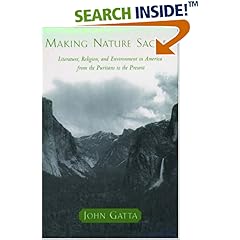
Making Nature Sacred: Literature, Religion, and Environment in America from the Puritans to the Present
Description
Since colonial times, the sense of encountering an unseen, transcendental Presence within the natural world has been a characteristic motif in American literature and culture. American writers have repeatedly perceived in nature something beyond itself-and beyond themselves. In this book, John Gatta argues that the religious import of American environmental literature has yet to be fully recognized or understood. Whatever their theology, American writers have perennially construed the nonhuman world to be a source, in Rachel Carson's words, of "something that takes us out of ourselves."
Making Nature Sacred explores how the quest for "natural revelation" has been pursued through successive phases of American literary and intellectual history. And it shows how the imaginative challenge of "reading" landscapes has been influenced by biblical hermeneutics. Though focused on adaptations of Judeo-Christian religious traditions, it also samples Native American, African American, and Buddhist forms of ecospirituality. It begins with Colonial New England writers such Anne Bradstreet and Jonathan Edwards, re-examines pivotal figures such as Henry Thoreau and John Muir, and takes account of writings by Mary Austin, Rachel Carson, and many others along the way. The book concludes with an assessment of the "spiritual renaissance" underway in current environmental writing, as represented by five noteworthy poets and by authors such as Wendell Berry, Annie Dillard, Marilynne Robinson, Peter Matthiessen, and Barry Lopez.
This engaging study should appeal not only to students of literature, but also to those interested in ethics and environmental studies, religious studies, and American cultural history.
Review
"This is a subtle, learned, and complex book that makes important contributions to ecocriticism and to the ongoing discussion of the persistence of responses to the natural world that it makes sense to characterize as religious." --Christianity and Literature
"Gatta offers spiritual and imaginative hope for an age set on despair."--CHOICE
"Required reading for anyone interested not only in ecocriticism but also in an interdisciplinary approach to Christian nature spirituality."--Laurie J. Braaten, Professor of Biblical Studies, Judson College
"Gatta's ambitious work lushly draws the reader into Nature as the setting out of which the United States of America emerged.... [W]e commend Gatta's accomplishment." --Consciousness, Literature and the Arts
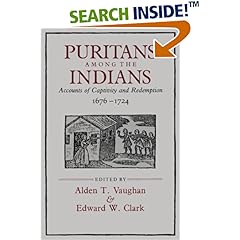
Puritans among the Indians: Accounts of Captivity and Redemption, 1676-1724 (The John Harvard Library)
Review
Until the publication of Puritans among the Indians, there was no edition of captivity narratives that so successfully brought together the twin themes of literature and ethnohistory...It is a joy to read a book so well made, intelligently edited, and carefully annotated...a model collection. (Western Historical Quarterly )
An exceptionally readable introduction to literature which is not only a significant source for colonial history and ethnography but also a revealing illustration of the Purtain but also a revealing illustration of the Puritan religious vision. (Church History )
This book is an excellent introduction to the genre of the Puritan captivity narrative. It includes several of the most well-known narratives (including Mary Rowlandson), each with a brief introduction. In addition, the editors have provided an introduction to the genre in general that is well-written and informative. The bibliography is extensive and invaluable.
The Puritan Origins of American Sex: Religion, Sexuality, and National Identity in American Literature
Description
Covering all new ground in the scholarship of religion and sexuality, the contributors address the Puritan and Protestant roots of American sexual identity and culture. Offering both historical and interdisciplinary breadth, the volume charts the influence of Protestantism on the shaping of the American character from Cotton Mather to Kenneth Starr. From witch trials to pickaxe murderers, from brothels to convents, and from slavery to Toni Morrison's Paradise, these essays provide fascinating and provocative insights into our sexual and religious conventions and beliefs.
Review
An intellectual joining of Sacvan Bercovitch's Puritan Origins of the American Self and Michel Foucault's History of Sex....[F]amiliar and unfamiliar figures, historical and modern, are revealed in a new light.....
–Religious Studies Review, January 2002
For those who imagine there is nothing more to say about the vexed relations between Puritanism and American sexuality, this richly inflected, shrewdly edited collection of essays holds many surprises. Treating the entire history of their associations, it adds a new chapter to our understanding of religion and the body in America.
–Giles Gunn, University of California, Santa Barbara
...nuanced, historically informed readings of Puritan discourses and their afterlives in later cultural texts.
–Glenn Hendler, University of Notre Dame, in the Journal of Religion
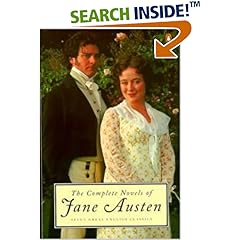
The Complete Novels of Jane Austen
Description
Jane Austen wrote in the eighteenth century, but her novels are timeless. This complete anthology is unique among single-volume editions of her work because it includes the obscure but delightful Lady Susan, along with the six better-known novels and thirty of Hugh Thomson's irresistible drawings.
All of Jane Austen's novels are love stories, all are stories of country gentry, and all end happily, one way or another. Her plots have the complexity of life and her characters are described with inimitable style and wit—whether caustic or warmly affectionate.
The novels contained in this anthology are Pride and Prejudice, Sense and Sensibility, Mansfield Park, Emma, Northanger Abbey, Persuasion, and Lady Susan. The nineteenth-century illustrations of Hugh Thomson capture the flavor of Jane Austen's characters and enhance this extraordinary collection of the complete works of one of the greatest novelists of all time
Review; By Amanda H. Duffy
Why do people still go on reading, quoting and making films about the novels of Jane Austen, a stay at home maiden lady who wrote her books almost two hundred years ago? An easy answer might be the romance and simplicity of the Austen age, where the most important news of the day was the arrival next door of a young, eligible bachelor. It was a world in which overheard conversations at a country dance, the imprudent behavior of a girl at a picnic, or a public snub in the village square would utterly change the course of your life. But this easy answer doesn't really explain the broad appeal of Jane Austen's novels. Her world is so unlike our own, that there simply must be more to it than romance. The fact is, that in spite of her limited experience, Jane Austen writes with tremendous wit, charm and perception. She appeals to the modern reader because she never minces words. She gets right into the heart of her characters, strips away the veneer of social grace, and makes shrewd observations about love, marriage, pride, snobbery, money and manners. Her opening sentences are a key to the clean, crisp writing you can expect from Austen. Take, for example, the character description that begins EMMA: "Emma Woodhouse, handsome, clever, and rich, with a comfortable home and happy disposition, seemed to unite some of the best blessings of existence, and had lived nearly twenty one years in the world with very little to distress or vex her." It is the brilliant use of the word 'seemed' that tips us off for the events that follow. In one sentence, Austen has given us a character who is spoiled, self assured and intelligent, and we can hardly wait to find out what is going to 'distress or vex her' in the following pages! Or what about the opening sentence of her most famous novel PRIDE AND PREJUDICE: "It is a truth universally acknowledged, that a single man in possession of a good fortune, must be in want of a wife." What a marvelous assumption, and what delightful matchmaking schemes and foibles are about to unfold! Just picking one of Austen's novels at random gives you a wealth of charming observation. Take these thoughts on conversation, from NORTHANGER ABBEY: "He shortly found himself arrived at politics, and from politics, it was an easy step to silence." ...and from "SENSE AND SENSIBILITY "Elinor agreed to it all, for she did not think he deserved the compliment of rational opposition." Or how about this wistful observation from PERSUASION: "One does not love a place the less because one has suffered in it." You don't have to be a scholar to understand and appreciate Austen. Her novels will surprise and win over any first time reader, and they have an amazingly good shelf life - they can be read and reread. Here, in one volume you have a portrait of missed opportunity in the provocative novel PERSUASION; matchmaking gone awry in EMMA; masterful observations of two sisters and their different approaches to love in SENSE AND SENSIBILITY; snobbery and manners in PRIDE AND PREJUDICE, and more. In short, Austen is a writer you never tire of. This is a must have in any collection, small or large!
Labels:
Classic Literature,
Jane Austen,
Literary Book,
Novels
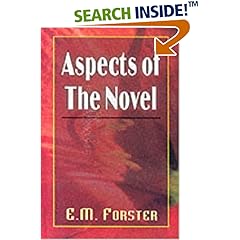
Aspects of the Novel
Reviews
Amazon.com
There are all kinds of books out there purporting to explain that odd phenomenon the novel. Sometimes it's hard to know whom they're are for, exactly. Enthusiastic readers? Fellow academics? Would-be writers? Aspects of the Novel, E.M. Forster's 1927 treatise on the "fictitious prose work over 50,000 words" is, it turns out, for anyone with the faintest interest in how fiction is made. Open at random, and find your attention utterly sandbagged.
Forster's book is not really a book at all; rather, it's a collection of lectures delivered at Cambridge University on subjects as parboiled as "People," "The Plot," and "The Story." It has an unpretentious verbal immediacy thanks to its spoken origin and is written in the key of Aplogetic Mumble: "Those who dislike Dickens have an excellent case. He ought to be bad." Such gentle provocations litter these pages. How can you not read on? Forster's critical writing is so ridiculously plainspoken, so happily commonsensical, that we often forget to be intimidated by the rhetorical landscapes he so ably leads us through. As he himself points out in the introductory note, "Since the novel is itself often colloquial it may possibly withhold some of its secrets from the graver and grander streams of criticism, and may reveal them to backwaters and shallows."
And Forster does paddle into some unlikely eddies here. For instance, he seems none too gung ho about love in the novel: "And lastly, love. I am using this celebrated word in its widest and dullest sense. Let me be very dry and brief about sex in the first place." He really means in the first place. Like the narrator of a '50s hygiene film, Forster continues, dry and brief as anything, "Some years after a human being is born, certain changes occur in it..." One feels here the same-sexer having the last laugh, heartily.
Forster's brand of humanism has fallen from fashion in literary studies, yet it endures in fiction itself. Readers still love this author, even if they come to him by way of the multiplex. The durability of his work is, of course, the greatest raison d'ĂȘtre this book could have. It should have been titled How to Write Novels People Will Still Read in a Hundred Years. --Claire Dederer --This text refers to the Paperback edition.
Book Description
Forester's wit and lively, informed originality have made this study of the novel a classic. Avoiding the chronological approach of what he calls "pseudoscholarship," Forster freely examines elements that all English-language novels have in common: story, people, plot, fantasy, prophecy, pattern and rhythm. The reader comes away with a deeper appreciation for the novel in general, also for Forster, himself a distinguished author (HOWARDS END and A PASSAGE TO INDIA).
"We discover, under [Forster's] casual but acute guidance, many things about the literary magic which transmute the dull stuff of He-said and She-said into characters, stories, and intimations of truth." (Harper's Magazine) --This text refers to an out of print or unavailable edition of this title.
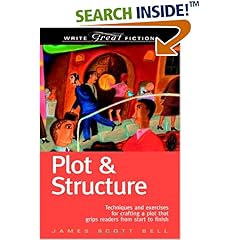
Plot & Structure: (Techniques And Exercises For Crafting A Plot That Grips Readers From Start To Finish) (Write Great Fiction)
escription
The second book in the Write Great Fiction series, Plot & Structure offers clear and concise information on creating a believable and engaging plot that readers can't resist. Written by award-winning thriller and suspense author James Scott Bell, this handy instruction guide provides:
* Easy-to-understand techniques on every aspect of plotting and structure, from brainstorming story ideas to building scenes, and from using subplots to crafting knock-out endings
* Engaging exercises, perfect for writers at any level and at any stage in their novel
* Practical and encouraging guidance from one of the most respected writers publishing today
Full of diagrams, plot brainstormers, and examples from popular novels, mastering plot and structure has never been so simple.
About the Author
A former trial lawyer, James Scott Bell is the award-winning author of The Darwin Conspiracy, Deadlock, Final Witness, and the Shannon Saga series. A frequent speaker at writing conferences, he resides in Woodland Hills, California.
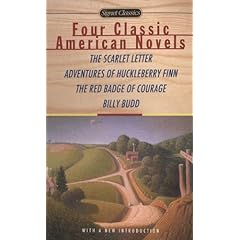
Four Classic American Novels: The Scarlet Letter, Adventures of Huckleberry FinnThe Red Badge Of Courage, Billy Budd
Description
An adulteress, a runaway boy, a terrified soldier, and a maltreated sailor-all the heroes of these must-read novels have become part of our American literary heritage.
Subscribe to:
Posts (Atom)