This blog contains something related to Literature such as drama, novel, literary research, film
Monday, October 20, 2008
Complete Works of William Shakespeare (Wordsworth Special Editions) (Wordsworth Royals Series)
William Shakespeare (1564-1616) is acknowledged as the greatest dramatist of all time. He excels in plot, poetry and wit, and his talent encompasses the great tragedies of Hamlet, King Lear, Othello and Macbeth as well as the moving history plays and the comedies such as A Midsummer Night's Dream, The Taming of the Shrew and As You Like It with their magical combination of humour, ribaldry and tenderness. This volume is a reprint of the Shakespeare Head Press edition, and it presents all the plays in chronological order in which they were written. It also includes Shakespeare's Sonnets, as well as his longer poems Venus and Adonis and The Rape of Lucrece.
This complete and unabridged edition contains every word that Shakespeare wrote — all 37 tragedies, comedies, and histories, plus the sonnets. You'll find such classics as The Tempest, Much Ado About Nothing and The Taming of the Shrew. This Library of Literary Classics edition is bound in padded leather with luxurious gold-stamping on the front and spine, satin ribbon marker and gilded edges. Other titles in this series include: Charlotte & Emily Bronte: The Complete Novels; Edgar Allan Poe: Selected Works; Mark Twain: Selected Works; Charles Dickens: Four Complete Novels; Lewis Carroll: The Complete, Fully Illustrated Works; and Jane Austen: The Complete Novels.
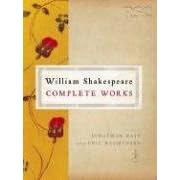
William Shakespeare Complete Works (Modern Library)
FROM THE WORLD FAMOUS ROYAL SHAKESPEARE COMPANY, THE FIRST AUTHORITATIVE, MODERNIZED, AND CORRECTED EDITION OF SHAKESPEARE’S FIRST FOLIO IN THREE CENTURIES.
Skillfully assembled by Shakespeare’s fellow actors in 1623, the First Folio was the original Complete Works. It is arguably the most important literary work in the English language. But starting with Nicholas Rowe in 1709 and continuing to the present day, Shakespeare editors have mixed Folio and Quarto texts, gradually corrupting the original Complete Works with errors and conflated textual variations.
Now Jonathan Bate and Eric Rasmussen, two of today’s most accomplished Shakespearean scholars, have edited the First Folio as a complete book, resulting in a definitive Complete Works for the twenty-first century.
Combining innovative scholarship with brilliant commentary and textual analysis that emphasizes performance history and values, this landmark edition will be indispensable to students, theater professionals, and general readers alike.
For more information on this Modern Library edition, visit www.therscshakespeare.com
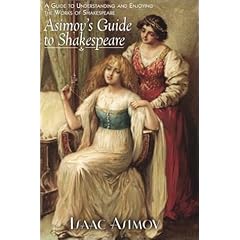
Asimov's Guide to Shakespeare: A Guide to Understanding and Enjoying the Works of Shakespeare
Shakespeare's genius is marked by his rare ability to appeal to theatergoers of all types and all levels of education. But for most modern folks, the Greek and Roman mythology and history, let alone the history of England and the geography of sixteenth-century Europe that his works are laden with, are hardly within our grasp. Isaac Asimov comes to making obscure issues clear to the layperson, selects key passages from 38 of the great bard's plays plus two of his narrative poems and, with the help of beautifully rendered maps an figures, illuminates us about their historical and mythological background.
While watching or reading one of Shakespeare's plays, it's interesting to read the notes of some of the different critics. Peter Levi does a wonderful job following the poetry and language of Shakespeare as it develops over his lifetime, in the context of the other writers of his era. Harold Bloom, of course, finds in Shakespeare both a mirror and an impulse for a leap forward in literature and therefore in society. Bloom has fallen in love with certain of Shakespeare's characters (Falstaff, Hamlet, etc.) and uses them as a yardstick for all others.
Asimov takes a more historical view. He has done impressive research into the characters and times. His "Guide to Shakespeare" is useful for its insights into all of the plays, but I found it most useful for the English histories. In the eight plays of the Wars of the Roses --from Richard II, through the Henrys, and culminating in Richard III-- Asimov tracks the family trees and politics of the nobility, spots anachronisms, and does a wonderful job of simplifying the sometimes bewildering array of characters and historical references. Of course, even uneducated audiences in Shakespeare's day would have understood some of these arcane references without a guidebook, much as a modern US audience would easily understand references to Thomas Jefferson or Abraham Lincoln. With his research and clear writing, Asimov brings the history plays --and indeed all of the plays-- back to life.
Friday, October 10, 2008
Classic Literature : Sense and Sensibility
Description
In her first published novel, Sense and Sensibility, Jane Austen presents us with the subtle portraits of two contrasting but equally compelling heroines. For sensible Elinor Dashwood and her impetuous younger sister Marianne the prospect of marrying the men they love appears remote. In a world ruled by money and self-interest, the Dashwood sisters have neither fortune nor connections. Concerned for others and for social proprieties, Elinor is ill-equipped to compete with self-centered fortune-hunters like Lucy Steele, while Marianne's unswerving belief in the truth of her own feelings makes her more dangerously susceptible to the designs of unscrupulous men.
Through her heroines' parallel experiences of love, loss, and hope, Jane Austen offers a powerful analysis of the ways in which women's lives were shaped by the claustrophobic society in which they had to survive. This revised edition contains new notes, appendices, chronology, and bibliography.
About the Author
Margaret Anne Doody has edited and introduced many texts for OWC and Penguin, including novels by Frances Burney and Charlotte Lennox. She is the editor of Austen's Catharine and Other Writings in OWC. She is the author of The True Story of the Novel (HarperCollines/Fontana 1998) and novels featuring the detective Aristotle. Claire Lamont has edited novels by Walter Scott and Austen for OWC and Penguin. She is the textual editor of Penguin's edition of Jane Austen's novels.
Subscribe to:
Posts (Atom)